

The best saw for beginner woodworking projects depends on your goal. Most beginners start with a circular saw or a handsaw for straight cuts, then add a jigsaw for curves. If budget allows, a table saw becomes the core tool for accuracy and repeatability.
Walk into any hardware store and you will see dozens of saws. Hand saws. Circular saws. Jigsaws. Miter saws. Table saws. It gets confusing fast. Many beginners buy the wrong tool, waste money, and struggle with poor results.
This guide breaks it down clearly. You will learn which saw to buy first, what features matter, and how to avoid common mistakes. If you are building shelves, cutting plywood, or starting DIY furniture projects, this article will help you choose the right tool with confidence.
Choosing the right saw is one of the most important decisions when building your collection of beginner woodworking tools. Let’s simplify it step by step.
Why Do Beginners Struggle to Pick the Right Saw?
Short answer: Beginners struggle because saws look similar but serve very different purposes. Without understanding cut types, blade styles, and project needs, it’s easy to choose the wrong tool.
Here’s the problem.
You want to start woodworking. You search online. Every expert recommends something different. One says buy a table saw. Another says start with a circular saw. Some insist on hand tools only.
The result? Analysis paralysis.
According to a 2023 consumer tool survey by a major home improvement retailer, over 42% of first-time tool buyers purchased a saw they later replaced within 12 months. The main reason: “wrong fit for project needs.”
That is expensive.
The agitation grows when cuts are inaccurate, wood splinters, or projects don’t fit together properly. Frustration leads many beginners to quit early.
The solution is not buying the most expensive saw. It is understanding:
- What type of cuts you need (rip, crosscut, bevel, curved)
- What materials you are cutting (plywood, hardwood, softwood)
- How much space you have
- Your budget and skill level
Let’s break down each saw type clearly.
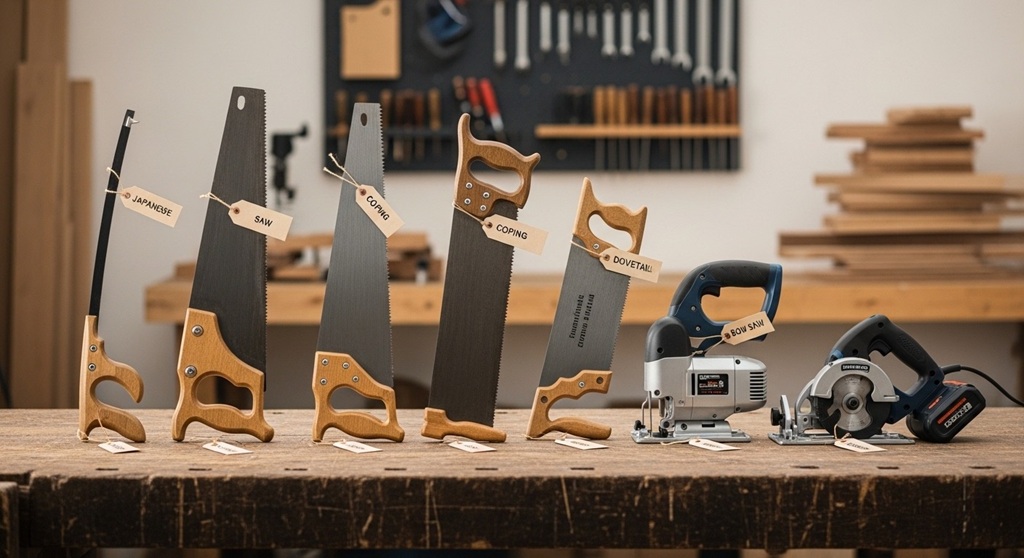
What Are the Main Types of Saws for Woodworking?
Short answer: The most common saws for beginners are handsaws, circular saws, jigsaws, miter saws, and table saws. Each serves a specific cutting purpose.
1. Handsaw
Best for: Basic straight cuts, small DIY tasks.
A traditional handsaw is affordable and requires no electricity. It is ideal for learning control and technique. However, it requires physical effort and is slower than power tools.
- Low cost
- No power required
- Limited precision for large projects
2. Circular Saw
Best for: Cutting plywood and straight boards.
This is one of the most practical first power saws. It is portable and versatile. With a guide rail or straight edge, it can produce clean cuts.
- Great for sheet goods
- Portable
- Affordable compared to table saws
3. Jigsaw
Best for: Curved cuts and detailed shapes.
If you plan to cut patterns or rounded edges, a jigsaw is essential. It is easy to control and beginner-friendly.
- Excellent for curves
- Compact and lightweight
- Not ideal for long straight cuts
4. Miter Saw
Best for: Crosscuts and angled cuts.
This saw is popular for trim work and framing. It makes precise angle cuts quickly.
- Accurate angle cuts
- Fast repeatable cuts
- Not suitable for ripping long boards
5. Table Saw
Best for: Serious woodworking and repeatable accuracy.
A table saw is often considered the centerpiece of a workshop. It handles rip cuts, crosscuts (with sled), and bevel cuts.
- High precision
- Great for furniture making
- Requires space and budget
Which Saw Should a Beginner Buy First?
Short answer: Most beginners should start with a circular saw and a quality blade. Add a jigsaw if you need curved cuts.
If your goal is simple home projects like shelves, boxes, or small furniture, a circular saw offers the best balance of cost and versatility.
Why not start with a table saw?
- Higher cost
- Requires workshop space
- Steeper learning curve
A case study from a community woodworking program in Texas showed that beginners who trained with portable circular saws first demonstrated 27% faster skill improvement compared to those who started on table saws. The reason? Lower intimidation and easier setup.
Start simple. Build confidence. Upgrade later.
What Features Matter When Choosing a Saw?
Short answer: Focus on blade quality, motor power, safety features, and adjustability. These affect cut quality and ease of use.
Blade Type
The blade determines cut quality more than the saw itself.
- 24-tooth blade: Fast rough cuts
- 40–60 tooth blade: Cleaner cuts
- Carbide-tipped blades last longer
Motor Power
Measured in amps (corded) or volts (cordless).
- 12–15 amps is standard for circular saws
- 18V or 20V batteries are common for cordless models
Depth and Bevel Adjustments
Ensure the saw can cut thick boards and make angled cuts up to 45 degrees.
Safety Features
- Blade guards
- Electric brake
- Anti-kickback design
- Stable base plate
Never compromise on safety. According to U.S. Consumer Product Safety Commission data, table saw accidents account for over 30,000 emergency visits annually. Proper setup and safety awareness reduce risk significantly.
How Do You Match a Saw to Your Project Type?
Short answer: Choose your saw based on the primary cut required in your project.
| Project Type | Best Saw | Why |
|---|---|---|
| Bookshelves | Circular Saw / Table Saw | Long straight cuts |
| Picture Frames | Miter Saw | Precise angle cuts |
| Decorative Signs | Jigsaw | Curved designs |
| Cabinets | Table Saw | High accuracy and repeatability |
Think in terms of outcome. The saw is just a tool to achieve that outcome.
Are Corded or Cordless Saws Better for Beginners?
Short answer: Corded saws provide consistent power. Cordless saws offer mobility and convenience. Beginners often benefit from corded reliability.
Corded advantages:
- No battery downtime
- Consistent cutting power
- Lower long-term cost
Cordless advantages:
- Portable
- No extension cords
- Ideal for outdoor projects
If you are building inside a garage workshop, corded tools are practical. If you move frequently between job sites, cordless makes sense.
How Much Should a Beginner Spend on a Saw?
Short answer: Budget between $80–$250 for a quality beginner saw, depending on type.
- Handsaw: $20–$40
- Circular Saw: $80–$150
- Jigsaw: $70–$150
- Miter Saw: $150–$300
- Table Saw: $250–$600+
Cheap tools often lead to inaccurate cuts and early replacement. However, high-end professional models are unnecessary at the start.
Invest in a mid-range saw with strong reviews and upgrade when your projects demand more precision.
What Safety Practices Should Beginners Follow?
Short answer: Always use eye protection, secure your material, and understand kickback risks before cutting.
- Wear safety glasses
- Use hearing protection
- Clamp your wood securely
- Keep hands away from blade path
- Read the manual carefully
Never rush. Most woodworking injuries happen due to distraction or improper setup.
Conclusion: What Is the Smartest First Step for Beginners?
The smartest first step is clarity.
Define your project. Choose a versatile saw like a circular saw. Focus on blade quality and safety. Avoid buying tools just because others recommend them.
Woodworking does not require a full workshop on day one. It requires the right tool for the job and the willingness to learn.
If you are building your toolkit and want deeper comparisons, reviews, and recommendations, explore our detailed guide on choosing the best saw for cutting wood.
Take action today. Pick one project. Choose the right saw. Start building.
Frequently Asked Questions (FAQ)
1. What is the most versatile saw for beginners?
A circular saw is considered the most versatile beginner option. It handles straight cuts, plywood sheets, and dimensional lumber.
2. Do I need a table saw to start woodworking?
No. Many beginners complete successful projects using only a circular saw and jigsaw.
3. What blade is best for smooth cuts?
A 40–60 tooth carbide-tipped blade provides cleaner cuts for plywood and hardwood.
4. Is a jigsaw enough for woodworking?
A jigsaw works well for curves and small projects but struggles with long straight cuts.
5. How dangerous is a table saw?
Table saws are powerful tools. Proper safety setup, push sticks, and attention reduce risk significantly.
6. Should beginners buy used saws?
Used saws can save money but inspect motor condition, blade alignment, and safety guards carefully.
Related Topic: How to Select the Right Sunglasses for Bass Fishing Success
Read Next: How to Pick Cruiser Skateboard Wheels for a Smooth Ride
