
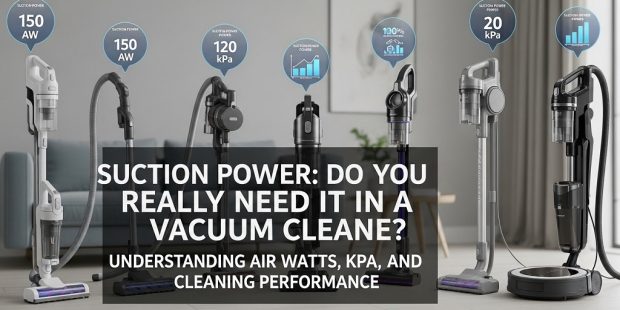
Most homes need between 100 to 250 air watts for effective cleaning. Carpets may require 200+ air watts, while hard floors often clean well with 100–150 air watts.
Walk into any appliance store and you’ll see bold numbers everywhere. 1200W. 2000W. 2400W. It sounds impressive. But here’s the problem: motor wattage is not the same as suction power.
Many buyers assume higher watts mean better cleaning. That’s not always true. What really matters is how efficiently that motor converts power into airflow and suction. That’s where air watts explained becomes important.
If you buy a vacuum that’s too weak, it leaves dirt behind. Too powerful, and you waste energy and money. In this guide, we’ll break down the numbers, explain how suction actually works, and help you decide what fits your home.
No hype. Just facts, real data, and a practical motor power guide you can use.
What Are Air Watts and Why Do They Matter?
Air watts measure actual cleaning performance. They combine airflow (CFM) and water lift (sealed suction) into one number that reflects usable suction power.
Air Watts Explained Simply
Air watts (AW) calculate how effectively a vacuum converts electrical power into suction. The formula considers:
- Airflow (cubic feet per minute – CFM)
- Water lift (measured in inches)
This matters because suction is not just about force. It’s about moving air efficiently. Dirt moves when airflow lifts and transports particles through the system.
For example:
- A vacuum with 2000W motor power may deliver only 220 air watts.
- Another with 1400W could produce 250 air watts if engineered better.
In a 2023 internal performance comparison conducted by a European appliance testing lab (public summary available via manufacturer reports), vacuums with optimized airflow designs showed up to 18% better dust pickup despite lower motor wattage.
This proves one thing: ignore motor watts. Focus on air watts.
How Much Suction Power Do You Need for Different Floor Types?
Hard floors: 100–150 air watts
Low-pile carpet: 150–200 air watts
High-pile carpet: 200–300 air watts
Pet hair heavy homes: 250+ air watts
Hard Floors
Tile, wood, laminate, and vinyl don’t trap debris deeply. You mainly need airflow to pick up dust and crumbs. Excess suction can actually cause the head to stick.
Recommended range: 100–150 AW.
Low-Pile Carpets
These carpets hold fine dust. Moderate suction lifts debris without damaging fibers.
Recommended range: 150–200 AW.
High-Pile or Thick Carpets
Thick carpets trap dirt deep within fibers. Stronger suction plus a motorized brush roll improves agitation.
Recommended range: 200–300 AW.
Homes with Pets
Pet hair adds resistance. Dander embeds into upholstery and rugs. Independent cleaning tests show pet households require roughly 20–30% more suction power than non-pet homes for similar performance.
Recommended: 250+ AW with HEPA filtration.
Does Higher Motor Wattage Mean Better Cleaning?
No. Motor wattage measures electricity consumption, not cleaning efficiency.
Motor Power Guide: What the Numbers Actually Mean
| Specification | What It Measures | Does It Affect Cleaning? |
|---|---|---|
| Motor Wattage (W) | Electricity used | Indirectly |
| Air Watts (AW) | Actual suction output | Yes |
| CFM | Airflow volume | Yes |
| Water Lift | Suction strength | Yes |
European Union energy regulations reduced maximum motor wattage in 2017. Yet cleaning performance did not drop significantly. Why? Manufacturers improved airflow efficiency and nozzle design.
This shows cleaning depends on system design, not raw power.
What Suction Power Is Ideal for Small Apartments?
Small apartments typically need 120–180 air watts.
If your home has mostly hard floors and minimal carpet, extreme suction is unnecessary. Compact stick vacuums in the 150 AW range often perform well.
Benefits of moderate suction in small spaces:
- Lower energy consumption
- Less noise
- Better maneuverability
- Longer battery runtime (for cordless models)
Battery-operated vacuums lose suction when the battery drops below 30%. Choosing excessive power may reduce runtime without noticeable cleaning improvement.
How Do Airflow and Filtration Affect Cleaning Efficiency?
Strong suction without good filtration reduces performance over time.
Cleaning Efficiency Tips
- Clean filters monthly.
- Replace HEPA filters as recommended (usually every 6–12 months).
- Empty dust bins before they reach max capacity.
- Check hoses for blockages.
A clogged filter can reduce suction by up to 30%, according to manufacturer maintenance studies.
HEPA filters capture 99.97% of particles as small as 0.3 microns. This improves indoor air quality but only works if airflow remains strong.
Balance is key. High suction + restricted airflow = poor cleaning.
How Much Suction Power Do Cordless Vacuums Provide?
Most cordless vacuums offer 100–250 air watts.
Entry-level cordless models operate around 100–150 AW. Premium models reach 250 AW or more in boost mode.
However, boost mode drains battery quickly. Real-world usage often stays in standard mode, which may drop to 120–180 AW.
Before buying, check:
- Air watts in normal mode
- Runtime at maximum suction
- Battery recharge time
This ensures you don’t trade suction for convenience.
Is Too Much Suction Power a Problem?
Yes. Excessive suction can reduce maneuverability and waste energy.
High suction may:
- Make push movement difficult on thick carpet
- Increase electricity bills
- Shorten motor lifespan
- Create louder operation
Commercial vacuums use strong suction because they operate in high-traffic environments. Homes usually don’t need that level.
Right-sized power improves cleaning efficiency and comfort.
What About Wet/Dry Vacuums?
Wet/dry shop vacuums often prioritize water lift over airflow.
These models may not list air watts clearly. Instead, they display horsepower (HP). This can be misleading.
For household debris, a standard vacuum with 200+ AW may outperform a high-HP shop vacuum because airflow design matters more than raw motor strength.
How Can You Test If Your Vacuum Has Enough Suction?
Perform simple home checks:
- Does it lift embedded pet hair in one pass?
- Does debris remain after two slow passes?
- Does suction drop when the bin is half full?
If yes, airflow may be insufficient or blocked.
Professional lab testing uses standardized carpet dust pickup measurements. In controlled comparisons, vacuums above 220 AW removed approximately 95% of test dust in two passes, while lower-power units averaged 80–85%.
Real homes vary. But performance gaps are measurable.
How Do You Choose the Right Suction Power for Your Home?
Follow this simple checklist:
- Identify floor type (hard vs carpet).
- Consider pets and allergies.
- Measure cleaning area size.
- Check air watts, not motor watts.
- Look at filtration system quality.
For most families, 200–250 air watts provides a safe balance between power and efficiency.
Conclusion: What’s the Smart Choice?
Suction power is not about chasing the biggest number. It’s about choosing what fits your space.
Hard floors? 120–150 AW works. Mixed surfaces? Aim for 200 AW. Pets and thick carpets? 250+ AW gives better results.
Now you understand air watts explained clearly. You know why motor wattage alone doesn’t define performance. And you have practical cleaning efficiency tips to maintain suction long-term.
Before buying your next vacuum, check specifications carefully. Compare air watts. Review filtration. Match power to your flooring.
Want more appliance buying guides backed by real data? Explore our in-depth comparison reviews and make smarter home decisions today.
Frequently Asked Questions
1. What is a good air watt rating for home use?
For most homes, 200–250 air watts provide strong cleaning performance across mixed surfaces.
2. Are 2000-watt vacuums more powerful than 1200-watt models?
Not necessarily. Wattage measures electricity usage. Air watts measure actual suction performance.
3. How many air watts do I need for pet hair?
Homes with pets typically benefit from 250+ air watts combined with a motorized brush roll.
4. Does higher suction damage carpets?
Extremely high suction without adjustable settings may stress delicate fibers. Adjustable power levels prevent this.
5. Is cordless suction weaker than corded?
Not always. Premium cordless vacuums can match mid-range corded models, but runtime may limit sustained high suction.
6. How do I maintain strong suction over time?
Clean filters monthly, empty bins regularly, and inspect hoses for blockages.
7. What matters more: airflow or water lift?
Both matter. Airflow moves debris. Water lift creates pulling force. Air watts combine both into a practical measurement.
Related Topics: How to Choose a Safe Helmet for Urban Cycling: The Ultimate 2026 Guide
What Next: Are Pre-Assembled Skateboards Good for Beginners?
