
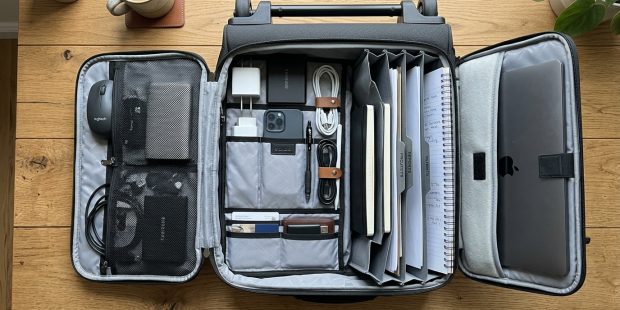
Your shoulder aches before you even reach the platform. The laptop you carry is light enough on its own, but add a charger, a folder, a water bottle, and a packed lunch, and a daily commute starts to feel like manual labor. That is often the moment people begin searching for a top-rated wheeled bag for laptops and travel gear, hoping to trade shoulder strain for a smooth roll. But not every rolling bag survives years of escalators, curbs, and crowded trains. The right choice comes down to a handful of practical details.
Quick Answer
Choose a wheeled work bag by matching the wheel type to your route, the handle to your height, and the internal layout to your actual gear. For long commutes, a two-wheel bag with a sturdy telescopic handle and reinforced laptop sleeve usually holds up better than a lightweight spinner. Prioritize durability and real-world fit over extra pockets you will never use.
Key Takeaways
- Wheel type matters most: two-wheel bags roll over rough pavement and curbs better, while four-wheel spinners maneuver easily on smooth, flat floors.
- The telescopic handle should extend high enough that you do not stoop while walking.
- A padded, suspended laptop sleeve protects your device more than a flimsy divider does.
- Check the bag’s dimensions against your commute realities, including overhead racks, locker space, and office storage.
- Lighter does not always mean better; a bit of structure can mean better protection and longer life.
Start With Your Route, Not the Bag
Where you travel each day should decide what you buy. A commuter who walks three blocks on cracked sidewalks has very different needs from someone who rolls across polished airport terminals.
Two Wheels vs. Four Wheels
Two-wheel rolling bags tilt toward you and roll on two contact points. They handle uneven pavement, cobblestones, and shallow curbs more predictably. Four-wheel spinner bags roll upright in any direction, which is convenient on smooth floors but can wobble or catch on rough ground or grates.
What to Check Before Buying
- Measure the distance from your home to the transit stop. Longer walks favor two wheels for control.
- Note whether your route includes stairs. Many rolling bags are not designed to be carried up steps comfortably.
- Consider how much standing room you have on a packed train or bus.
The Handle Tells You a Lot About Build Quality
A wobbly handle is usually the first thing to fail on a cheap rolling bag. Look for a telescopic handle with minimal side-to-side play when fully extended. The handle should lock firmly at its height, and there should be at least two height settings if you are tall or short.
A useful test is to extend the handle and gently push it side to side. If it rattles noticeably, that looseness will only increase with use. Metal handles generally outlast plastic ones, though weight and price rise accordingly.
Laptop Protection Is Not Optional
For a work bag, the laptop compartment is the part you cannot compromise on. A rolling bag takes more bumps than a backpack because it is dragged rather than carried, so the protection needs to account for that.
- Suspended laptop sleeves keep the device off the bottom of the bag, away from impact.
- Thick foam padding absorbs shocks better than thin fabric dividers.
- A separate, quick-access laptop pocket saves you from unpacking the whole bag at security or in a meeting.
If you carry a tablet or a second device, check that the interior has enough structure to keep items from sliding into each other during movement.
Interior Layout and Realistic Capacity

More pockets do not automatically mean a better bag. What matters is whether the layout matches what you actually carry.
| Layout Feature | Why It Helps | When It Hurts |
|---|---|---|
| Multiple compartments | Keeps cables, chargers, and documents separate | Adds weight and bulk if you rarely use them |
| Expandable section | Useful for overnight trips or extra gear | Encourages overpacking on daily commutes |
| Front organizer panel | Quick access to pens, cards, and small items | Can bulge and crowd the main compartment |
| Mesh water bottle pocket | Keeps drinks separate from electronics | Takes space if unused |
Think about how you commute. If you frequently switch between train, bus, and walking, a simpler internal layout often serves you better because you can find things quickly, If you are considering high-end designer brands for your daily travel, it helps to know how to know if a michael kors bag is original.
Weight, Materials, and Long-Term Durability
The empty weight of the bag matters more than many buyers expect. A heavier bag adds to your load every single day, even when it is nearly empty. Ballistic nylon and heavy-duty polyester tend to resist abrasion well, while thinner fabrics wear through at corners and wheel housings.
Where Bags Fail First
- Wheel housings crack under repeated impact.
- Handles loosen at the locking mechanism.
- Zippers separate at the seams under strain.
- Bottom fabric tears from dragging.
Reinforced stitching at stress points and replaceable wheels are signs that a manufacturer expects the bag to last. These details are worth more than a stylish exterior.
Size, Storage, and Transit Rules
Before you decide, find out whether your bag will fit where it needs to go. Overhead bins, under-seat space, office lockers, and gym cubbies all impose limits.
A bag that is too large becomes a burden on crowded transit, and one that is too small forces you to carry a second bag. Measure your largest item, usually the laptop, and add clearance for a sleeve, charger, and cables. If your commute involves flights, check the airline’s carry-on dimensions before buying.
Common Mistakes to Avoid
- Buying purely on price and ignoring wheel and handle quality.
- Choosing a spinner for rough outdoor routes where it will struggle.
- Assuming a lightweight bag is automatically stronger.
- Overlooking handle height and developing back or shoulder strain.
- Ignoring the return policy in case the bag does not fit your gear.
Frequently Asked Questions
Are two-wheel or four-wheel rolling bags better for commuting?
Two-wheel bags generally handle uneven sidewalks, curbs, and transit gaps better. Four-wheel spinners are easier on smooth, flat floors such as airports and office buildings. For mixed outdoor routes, two wheels are usually the safer pick.
How much should a wheeled work bag weigh when empty?
There is no single correct number, but lighter is generally easier on long commutes. A bag that feels heavy before you add anything is worth reconsidering, especially if you carry a laptop and charger daily.
Can a rolling laptop bag be carried up stairs?
Most can, but many are awkward to lift because of their shape and handle placement. If your route includes regular stairs, look for a bag with a comfortable top or side grab handle and check its weight when loaded.
Is a hard-shell or soft-sided rolling bag better?
Soft-sided bags offer more flexible storage and often weigh less. Hard-shell options protect contents better against crushing but can be heavier and less forgiving when space is tight.
How do I know if the laptop compartment is safe enough?
Look for a suspended sleeve, thick padding on all sides, and a secure closure. If the laptop can shift or touch the bottom of the bag, protection is probably insufficient for daily rolling.
Conclusion
The best wheeled work bag for your commute is the one that fits your route, your gear, and your body. Focus on wheel type, handle stability, laptop protection, and honest capacity rather than marketing claims. Once you know your priorities, compare a few options side by side and check the return policy. A bag that rolls smoothly today should still roll smoothly a year from now, and that is the real measure of value.
